


The Two Kinds of LinkedIn Automation
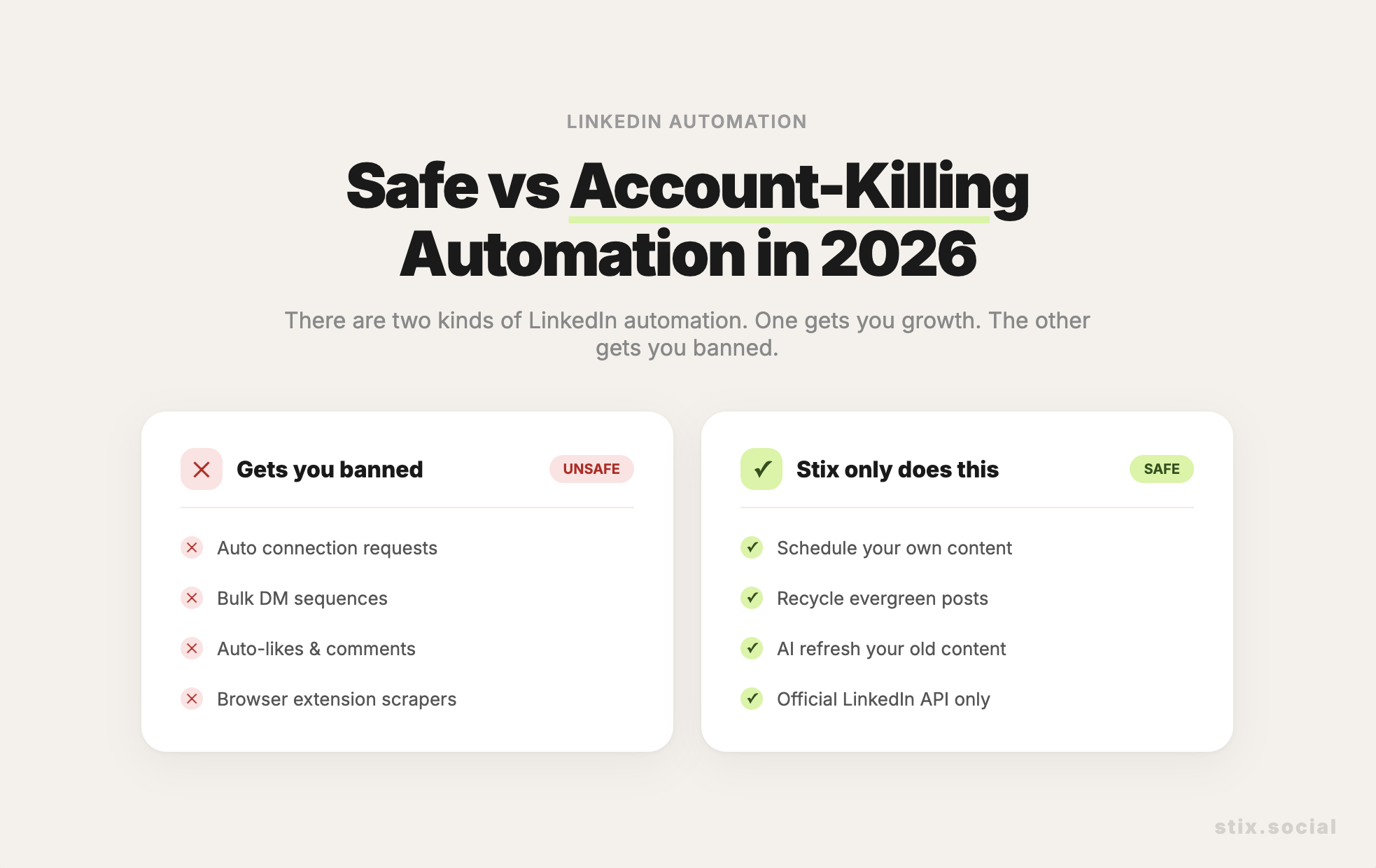
The first category, the dangerous one, automates interactions with other people. Connection requests sent at scale. DMs sent automatically based on triggers. Auto-likes and auto-comments on posts. Profile visits done by bots. This category exists in a permanent gray zone with LinkedIn's terms of service, and accounts using these tools get restricted, suspended, or permanently banned regularly.
The second category automates only your own content. Scheduling your posts to publish at a specific time. Recycling your evergreen content back into rotation. Using AI to refresh and rewrite posts you have already written. Generating PDF carousels from outlines. Posting to multiple LinkedIn pages from a single dashboard. This category is fully sanctioned by LinkedIn's official API and carries zero risk.
Almost every public conversation about "LinkedIn automation getting you banned" is about the first category. Almost every founder asking the question is actually thinking about the second. Once you separate the two, the question of whether to automate becomes obvious: yes for your own content, no for anything that touches other accounts.
What LinkedIn Actually Allows in 2026
LinkedIn's official position has been consistent for years and got tighter in 2025. Their API explicitly supports content scheduling, multi-account management for agencies, and analytics access. They have built integrations with companies like Stix, Buffer, Hootsuite, Sprout Social, and others through this official API.
What they do not allow, and have actively shut down, is anything that scrapes profile data, sends connection requests programmatically, automates messaging, or simulates human behavior to grow networks artificially. Tools that do these things use unofficial methods like browser extensions or headless browsers that LinkedIn can detect and block.
The rule of thumb is simple. If a tool needs to install a Chrome extension or asks you to leave your computer running overnight, it is probably operating in the gray zone. If it connects through the official LinkedIn API via OAuth and only handles content you would have posted yourself, it is safe.
How LinkedIn Detects Unsafe Automation
LinkedIn's detection systems look for behavioral patterns that humans do not produce. Activity at exactly 60-second intervals. Connection requests sent during sleep hours in your timezone. Messages with identical phrasing sent to dozens of people. Profile views that follow exact scripted patterns. Logins from server IP addresses associated with known automation tools.
Once flagged, accounts go through escalating restrictions. First a warning, then a temporary feature limit (you cannot send connection requests for a week), then an account hold requiring identity verification, then permanent restriction. Recovery from later stages is rare.
None of these signals fire for content scheduling. Publishing a post you wrote yourself, at a time you chose, through the official API, looks identical to publishing it manually. There is nothing to detect because nothing unusual is happening.
The Safe Automation Stack for 2026
If you are building your LinkedIn workflow this year, the safe stack looks like this.
Content scheduling. Use a tool that connects through the official LinkedIn API. Avoid anything that requires a browser extension to publish posts.
Content recycling. Automatically rotate your best-performing posts back into your queue every 60 to 90 days. This is publishing automation, not engagement automation, and is fully safe.
AI rewriting and refresh. Use AI to rewrite or restructure your own content. The risk here is to your brand voice, not to your account. As long as you are not using AI to mass-produce posts you would never have written, you are fine.
Carousel generation. PDF carousels are uploaded as document posts through the official API. Tools that generate them automatically are safe because the publish action is identical to a manual upload.
Analytics and reporting. Pulling your own analytics through the API is sanctioned. This is how tools show you which posts performed and when to repost them.
What to Avoid Even If It Tempts You
The unsafe category is worth listing explicitly because the marketing for these tools is aggressive and the promised results are seductive.
Tools that send connection requests at scale promise hundreds of new connections per week. The actual outcome for most users is a restricted account within 30 to 60 days. Even if you survive longer, the connections you build are low-quality and convert poorly.
Tools that automate DMs promise pipeline generation on autopilot. The actual outcome is a damaged reputation, low response rates, and an inbox full of angry replies from people who recognized the pattern.
Tools that auto-engage with other people's posts promise visibility through algorithmic gaming. The actual outcome is a feed full of obviously botted comments that hurt your credibility more than they help your reach.
None of these are worth the risk. The accounts of founders who get serious about LinkedIn are too valuable to gamble on.
The Stix Approach to Safe Automation
Stix was built specifically around the principle that the only safe LinkedIn automation is content automation. Stix only touches content you would have posted yourself. It does not send connection requests. It does not automate DMs. It does not engage with other people's posts on your behalf. It does not require browser extensions or background processes.
Everything Stix does goes through the official LinkedIn API via OAuth, which means there is nothing for LinkedIn to detect because nothing unusual is happening. You are publishing your own content at the times you chose. See how Stix automates LinkedIn safely for B2B founders and agencies who cannot afford to lose their accounts.
The Bottom Line
Safe LinkedIn automation in 2026 is not a contradiction. It is the entire point of using a real tool. Automate the publishing layer so you do not have to think about LinkedIn every day. Leave the engagement layer to humans because that is where trust is built and where authenticity matters. Founders who get this distinction right grow steadily. Founders who get it wrong get banned.