


Why Founders Outgrow Buffer on LinkedIn
Buffer was built when social media meant Twitter, Facebook, and Instagram. The product is excellent at what it does: queue a post, schedule it across multiple platforms, and forget about it until next week. For early-stage founders posting the same thing everywhere, that is genuinely useful.
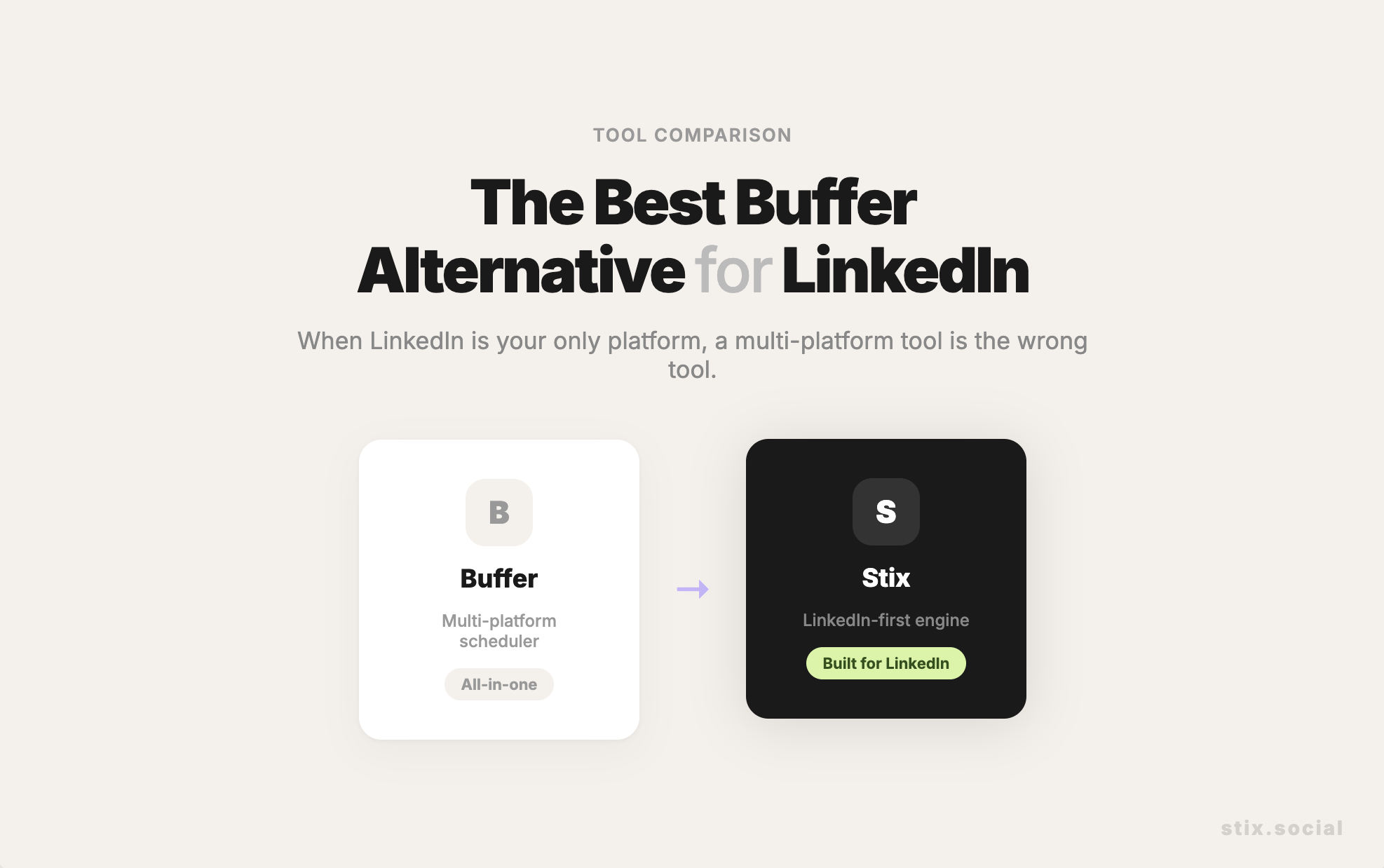
The problem starts when LinkedIn becomes your primary growth channel. LinkedIn is not just another social platform. It rewards consistency over virality, has a fundamentally different content lifecycle, and demands native formats like carousels and long-form posts that other platforms do not. A multi-platform tool optimizes for the lowest common denominator. That is exactly the wrong approach when one platform is doing 90 percent of the work.
The signs you have outgrown Buffer usually look like this. You stop posting to Twitter and Instagram but keep paying for those slots. Your best LinkedIn posts disappear forever after 48 hours because there is no recycling layer. You spend more time copying content into Buffer than you do actually writing it. And you cannot get carousels, polls, or document posts to schedule properly because Buffer treats them as second-class citizens.
What a Real LinkedIn-First Tool Looks Like
If you are evaluating Buffer alternatives specifically for LinkedIn, the feature checklist looks very different from a general scheduler. Here is what actually matters.
Native LinkedIn formats. PDF carousels, polls, document posts, and multi-image posts should publish exactly the way they would if you posted manually. No reformatting, no quality loss, no awkward image cropping.
Content recycling. Your best post from six months ago still works today. A LinkedIn-first tool treats your content library as an asset, not a one-time queue. Posts should rotate back into the schedule automatically based on category and freshness.
AI rewriting that respects your voice. Generic AI tools turn every post into the same beige soup. The right tool refreshes your existing content while preserving the way you actually write.
Category-based scheduling. You should be able to set rules like "Monday is a story, Wednesday is a framework, Friday is a customer win" and let the tool fill those slots from your content library.
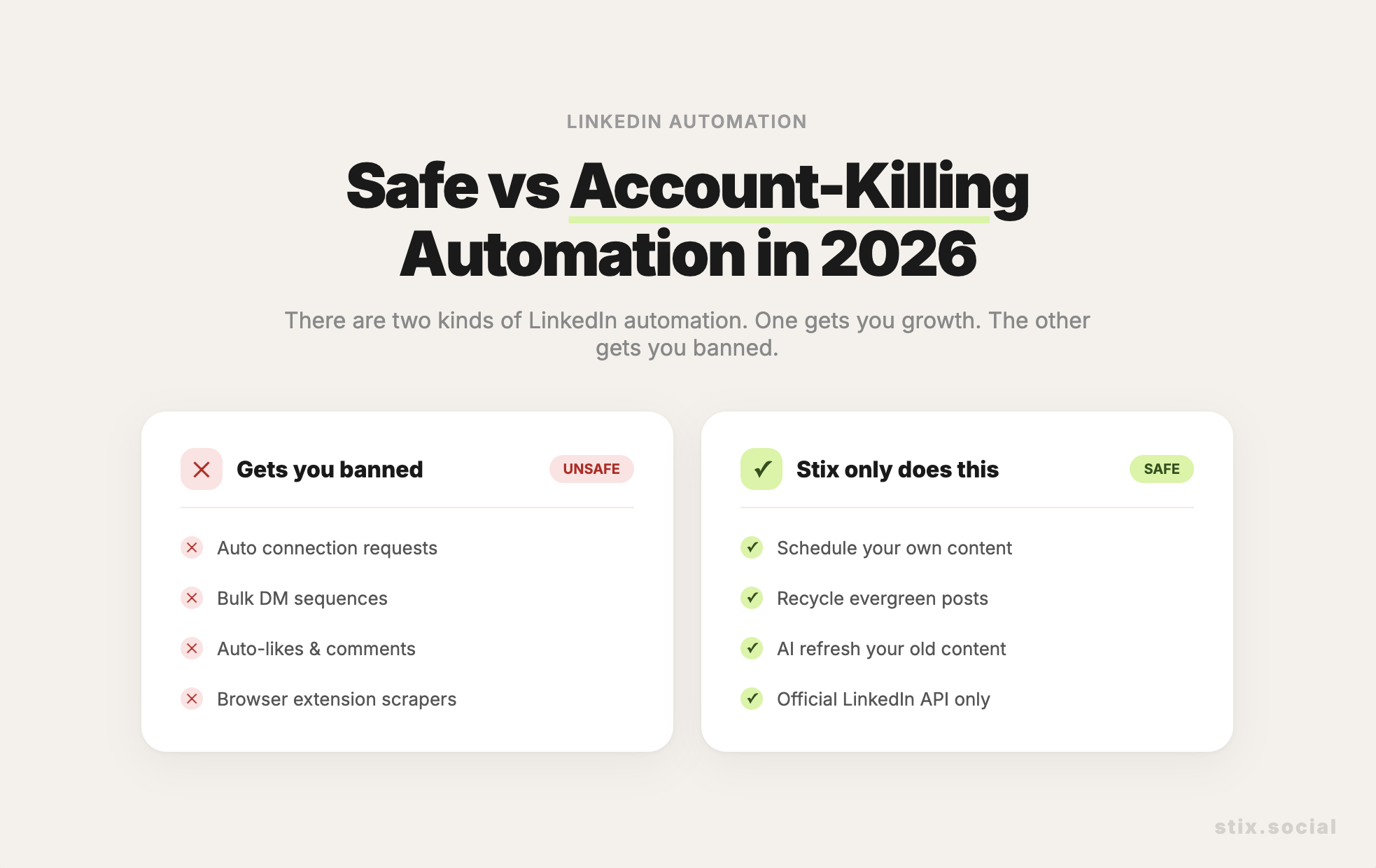
No connection or DM automation. This is non-negotiable. Tools that automate connection requests or messages put your account at risk of restriction. A safe LinkedIn tool only touches content you would have posted anyway.
The Honest Comparison: Buffer vs. The LinkedIn-First Alternatives
Buffer. Best for: solo founders posting the same content across three or more platforms. Weakness for LinkedIn: no recycling, no AI refresh, no native carousel scheduling, you pay for platforms you do not use. Pricing scales by channel which gets expensive fast if you add team members.
Hootsuite. Best for: enterprise teams with formal approval workflows. Weakness for LinkedIn: heavyweight interface, slow product iteration, pricing starts at a level that makes no sense for a founder. The LinkedIn-specific features are minimal.
Taplio. Best for: personal brand growth with AI content generation. Weakness: heavy AI generation can create generic-sounding content, and the recycling layer is weaker than the AI generation layer. Pricier than Buffer for a single account.
Stix. Best for: B2B founders and agencies who want LinkedIn consistency without the daily grind. Built only for LinkedIn from day one. Strengths: native PDF carousels, AI content recycling that preserves voice, category-based scheduling, unlimited team members per workspace, and zero connection automation. Weakness: if you actually need to post to Twitter or Instagram too, you will need Stix plus a basic scheduler. Most founders find that a smaller bill than Buffer alone.
The Migration Decision Framework
Switching tools always costs time. Here is a simple test for whether the switch is worth it.
Count the number of platforms you posted to in the last 30 days. If it is one (LinkedIn) or two (LinkedIn plus one other), a LinkedIn-first tool will save you money and produce better results. If it is three or more and they are all roughly equal in importance, stay with Buffer.
Then count the number of times you said "I should reuse that old post" but never did. If that number is greater than five, content recycling alone will pay for the switch. Most founders have written more good LinkedIn content than they realize. They just have no system for surfacing it again.
Finally, ask whether your LinkedIn content drives meaningful pipeline. If yes, it deserves better than the default tool. If no, the right move is probably to invest in content quality first, then upgrade your tooling once it matters.
How to Switch Without Losing Momentum
Migrating from Buffer to a LinkedIn-first tool takes about an hour if you do it right. Export your scheduled queue from Buffer, import your top-performing posts from the last six months as a content library in your new tool, set up your category rules and posting cadence, and connect your LinkedIn account through the official OAuth flow. From there, the new tool should handle scheduling, recycling, and AI refresh automatically.
The transition feels strange at first because LinkedIn-first tools require less daily attention than Buffer does. That is the point. You stop being a part-time content manager and go back to being a founder.
The Bottom Line
Buffer is a great product for what it was designed to do. It just was not designed to make B2B founders consistently visible on LinkedIn. If LinkedIn is where your customers are and where your pipeline comes from, the right tool is one that treats LinkedIn as the only thing that matters. That is the entire reason Stix exists. If you want to see what set-and-forget LinkedIn consistency actually looks like, try Stix free for 14 days.