


What Is LinkedIn Content Recycling?
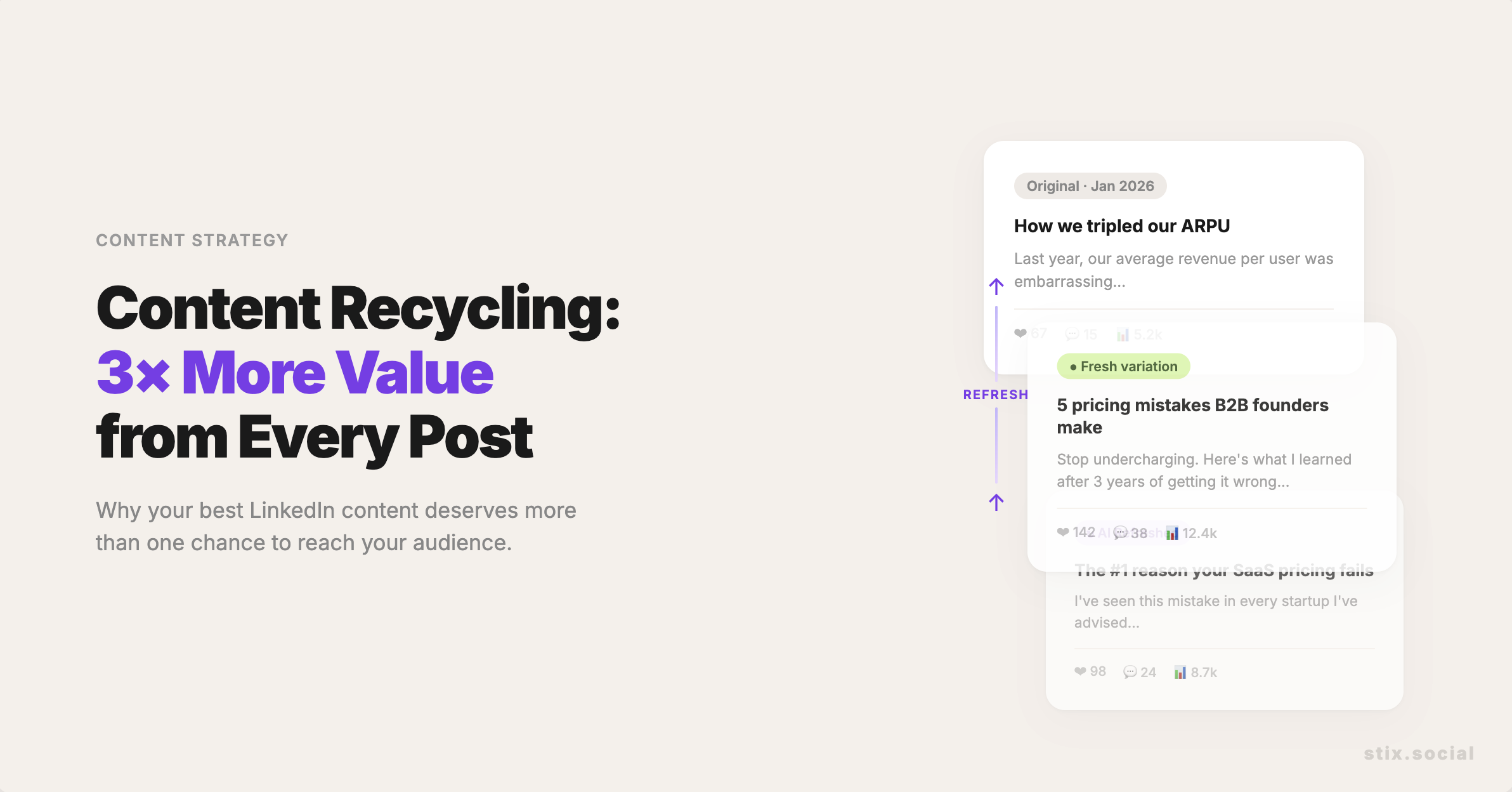
Content recycling is the practice of taking your highest-performing LinkedIn posts and resharing them weeks or months later with a fresh angle. It is not copying and pasting. It is not lazy reposting. It is a deliberate strategy that maximizes the return on every piece of content you create.
The logic is simple. Only 5 to 10 percent of your LinkedIn followers see any given post. That means up to 95 percent of your audience never saw your best work. Recycling ensures that your most valuable insights reach a wider portion of your network over time.
Why Recycling Works on LinkedIn
LinkedIn's algorithm does not penalize recycled content as long as it provides value and engagement. The platform prioritizes relevance and engagement signals over novelty. A well-crafted post about a timeless B2B topic will perform just as well the second time around if the presentation feels fresh.
There is also a psychological principle at play. The Mere Exposure Effect shows that people develop a preference for ideas they encounter repeatedly. When your audience sees your core messages multiple times in different formats, those messages become more trusted and more memorable. Repetition is not a weakness in content strategy. It is a feature.
Content Recycling vs. Reposting: The Critical Difference
Reposting is sharing the exact same text, image, and format again. It looks robotic and can damage your credibility if your audience notices.
Content recycling is taking the same core idea and changing the delivery. This can mean rewriting the hook, changing the format from text to carousel, updating the data or examples, or shifting the angle from educational to personal storytelling. The insight stays the same, but the package is new.
Think of it like a musician performing the same song at different concerts. The melody is the same, but the energy, arrangement, and crowd interaction make each performance unique.
How to Identify Posts Worth Recycling
Not every post deserves a second life. Focus on posts that meet at least two of these criteria: high engagement relative to your average, strong save or share count, addresses a frequently asked question from your audience, contains evergreen advice that remains relevant months later, or generated meaningful comments or direct messages.
Posts tied to a specific date, news event, or time-sensitive announcement are not good candidates for recycling. Posts that share timeless frameworks, practical tips, industry insights, or personal lessons are ideal.
Five Ways to Recycle a Single LinkedIn Post
Take one high-performing post and turn it into five distinct pieces of content using these approaches.
Change the hook. The opening line determines whether someone reads or scrolls past. Rewrite the first two sentences with a completely different angle. If the original started with a statistic, try starting with a personal story. If it started with a question, try starting with a bold statement.
Switch the format. Turn a text post into a PDF carousel. Turn a carousel into a short video. Turn a long post into a single-image quote card. LinkedIn rewards format diversity, and different formats reach different segments of your audience.
Update the examples. Replace the original case study or data point with a newer one. This makes the post feel current even though the underlying advice has not changed.
Shift the perspective. If the original was written as general advice, rewrite it as a personal story. If it was a personal story, rewrite it as a how-to guide. Same lesson, different lens.
Break it into parts. A long post with five tips can become five individual posts, each diving deeper into a single tip. This gives you a week of content from one original idea.
How Often Should You Recycle Content?
A safe recycling window on LinkedIn is 8 to 12 weeks. After two to three months, the vast majority of your audience will have forgotten the original post. New followers who joined since then will see it for the first time.
If you maintain a library of 40 to 50 evergreen posts and recycle each one every two to three months, you have a nearly endless content pipeline that requires minimal new creation.
Automating the Recycling Process
Manually tracking which posts to recycle and when is tedious. This is where automation tools make a significant difference. A tool like Stix is built specifically for this workflow. It identifies your top-performing posts, organizes them into content categories, generates AI-refreshed variations that preserve your voice, and schedules them into a rotation so your least-recently-used content surfaces automatically.
The result is a LinkedIn feed that stays active and fresh without requiring you to write new content from scratch every week. You spend your time reviewing and approving, not creating from a blank page.
The ROI of Content Recycling
Consider this math. You write 10 strong LinkedIn posts. Without recycling, those 10 posts each reach 5 to 10 percent of your audience and then disappear. Total reach: limited to one exposure per post.
With recycling, each of those 10 posts gets shared three to four times over the course of a year, each time with a fresh angle. Total reach: three to four times the original, with no additional writing effort. That is the compounding effect of content recycling. Every post you write becomes an asset that keeps working for months, not just hours.
Key Takeaways
Content recycling means resharing your best posts with a fresh angle, not copy-pasting. Only 5 to 10 percent of your followers see any given post, so recycling captures the other 90 percent. Wait 8 to 12 weeks before recycling a post. Change the hook, format, examples, or perspective to make each version feel new. Build a library of 40 to 50 evergreen posts for a nearly self-sustaining content pipeline. Use automation tools to handle the tracking, variation, and scheduling so you can focus on reviewing rather than writing from scratch.