


Why Most Founders Run Out of Ideas
Founders do not have a shortage of knowledge. They have a shortage of translation. You are deep in your industry every day. You have opinions, lessons, frameworks, and stories that your audience genuinely wants to hear. The problem is that inside your head, those insights feel obvious. Obvious does not feel worth posting.
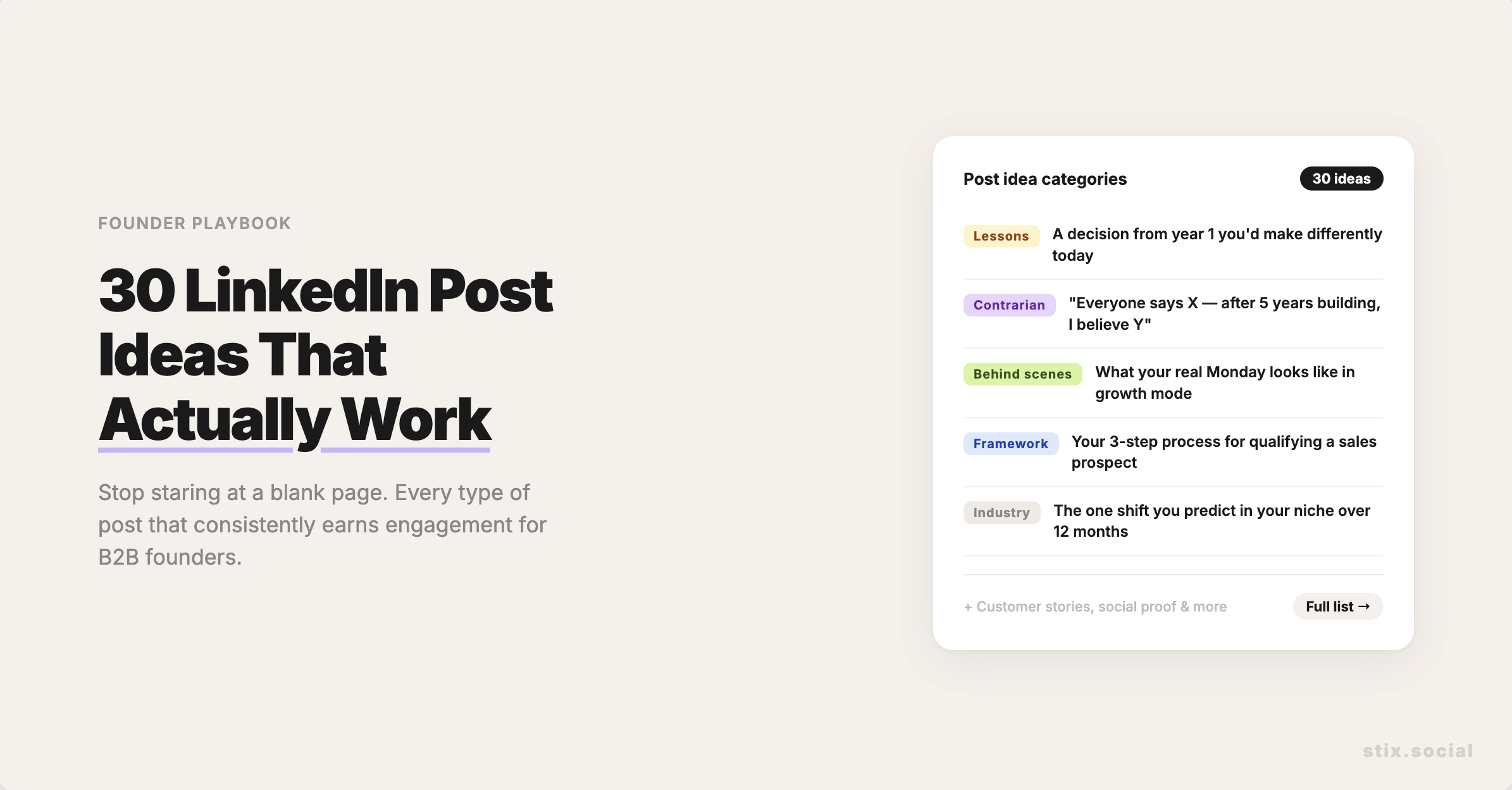
This list will help you see your everyday experiences as content. Every category below maps to a type of post that consistently performs well on LinkedIn for B2B founders. Pick five ideas from different categories and you have your first two weeks of content. Pick fifteen and you have a month. Build a library of thirty and you have the foundation of a self-sustaining content system.
Category 1: Lessons Learned the Hard Way
Posts about mistakes and hard lessons consistently outperform polished success stories on LinkedIn. Vulnerability creates connection. These five formats work reliably for founders.
Share a decision you made in year one that you would make differently today, and explain why. Write about a hire that did not work out and what the experience taught you about recruitment. Describe a product feature you shipped that nobody used and what you learned about listening to customers. Share a moment when you almost quit and what kept you going. Explain a pricing mistake you made early on and how fixing it changed your business.
Category 2: Contrarian Takes
Safe opinions get ignored. Opinions that challenge conventional wisdom start conversations. These contrarian formats work particularly well for founders who want to position themselves as independent thinkers.
Write a post that starts with "Everyone says X, but after building for 5 years, I believe Y." Challenge a piece of startup advice that you think is overrated. Share why a popular framework in your industry does not work for companies at your stage. Make the case for something your industry considers unimportant. Disagree publicly with a trend that your competitors are following.
Category 3: Behind-the-Scenes of Building
Your audience follows you because they want to understand what building a company actually looks like. These posts give them that view and build genuine trust through transparency.
Walk through what a typical Monday looks like when you are in growth mode. Share the Notion doc, spreadsheet, or system you actually use to track something in your business. Describe the conversation that led to your biggest product pivot. Show the earliest version of your landing page and compare it to today. Share a real email or Slack message that captures a defining moment in your company's story.
Category 4: Frameworks and How-To Guides
Practical, actionable content earns saves and shares. These posts build your reputation as someone who teaches rather than just talks. Saved posts are one of the strongest algorithmic signals on LinkedIn.
Explain the three-step framework you use to qualify sales prospects. Share the interview questions you ask that reveal whether a candidate will thrive in a startup environment. Break down how you structure your weekly one-on-ones with your team. Explain how you decide which features to build next using a prioritization method. Share the process you use to turn customer complaints into product improvements.
Category 5: Industry Observations and Trends
Position yourself as someone who reads the landscape better than anyone else in your space. These posts establish thought leadership without requiring personal stories.
Share your prediction for the single biggest shift in your industry over the next 12 months. Explain why a trend that everyone is excited about is overhyped. Identify a problem in your industry that nobody is talking about yet. Compare how your industry operated five years ago to how it operates today. Share what a recent news event means for the people in your niche.
Category 6: Customer Stories and Social Proof
Your customers' outcomes are more persuasive than anything you say about your own product. These posts combine authenticity with soft selling.
Tell the story of how a customer came to you with a specific problem and what happened after they started using your product. Share a result one of your customers achieved and the unexpected way they got there. Write about a use case for your product that you never anticipated when you built it. Share a piece of feedback that changed how you think about your product. Describe what your best customers have in common and why.
Building a System Around These Ideas
Thirty post ideas is a starting point, not a finish line. The goal is to build a content library where every idea becomes a reusable asset. Write the post once, add it to your library, and let it rotate. Your best lessons about hiring do not expire after one post. Your framework for qualifying prospects is just as valuable in six months as it is today.
Tools like Stix are built for exactly this workflow. You write your best ideas when inspiration strikes, organize them into categories, and Stix keeps rotating them through your feed so they reach every segment of your audience over time. The thirty ideas above are your raw material. A good content system turns that raw material into a LinkedIn presence that compounds month after month without burning you out.
Key Takeaways
Founders have more content ideas than they realize. The challenge is translating everyday experiences into posts. The six most reliable post categories for founders are lessons learned the hard way, contrarian takes, behind-the-scenes content, frameworks and how-to guides, industry observations, and customer stories. Build a library of evergreen posts from these categories rather than starting from scratch every week. A content library paired with a rotation system turns one-time posts into compounding assets that reach your full audience over time.