



Why Consistency Matters More Than Frequency
LinkedIn's algorithm rewards accounts that show up regularly. According to LinkedIn's own data, companies that post at least once per week see 5.6x faster follower growth than those that post less frequently. But here is the key insight most people miss: consistency does not mean posting every day. It means posting on a predictable rhythm that your audience and the algorithm can rely on.
Posting three times per week, every week, for six months will always outperform posting daily for two weeks and then going silent for three months. The algorithm tracks your posting patterns. When you disappear, your next post gets shown to fewer people. When you stay consistent, each post builds on the momentum of the last one.
The Real Reason Most People Stop Posting
The most common reason founders stop posting is not a lack of ideas. It is the friction of the process. Every post requires you to sit down, open a blank screen, think of a topic, write a draft, edit it, find an image, and hit publish. That workflow takes 30 to 60 minutes per post. Multiply that by three posts per week, and you are looking at up to three hours of content work every week.
For a founder juggling product development, sales calls, and team management, those three hours are nearly impossible to protect. The result is predictable: you skip a week, then two weeks, then a month, and suddenly your LinkedIn presence has gone dark.
Step 1: Build a Content Library, Not a Content Calendar
The shift from burnout to consistency starts with one mindset change. Stop thinking of LinkedIn content as something you produce weekly. Start thinking of it as a library of reusable assets.
A content calendar forces you to create something new every few days. A content library lets you write when you are inspired and draw from that library during busy weeks. The best LinkedIn creators maintain a bank of 30 to 50 evergreen posts that they rotate and refresh over time.
Evergreen posts are insights, tips, frameworks, or stories that remain relevant months after you first write them. A post about three mistakes founders make when pricing their SaaS product is just as valuable in June as it was in January.
Step 2: Categorize Your Content Into Pillars
Organize your library into three to five content categories. For a B2B founder, this might look like: industry insights and trends, lessons learned from building your company, practical tips your audience can apply immediately, customer success stories and case studies, and behind-the-scenes of your product or team.
When you assign each post to a category, you can create a simple rotation. Monday is for insights. Wednesday is for practical tips. Friday is for a personal story. This structure removes the daily decision of what should I post about and replaces it with a predictable system.
Step 3: Batch Your Writing Sessions
Instead of writing one post at a time, three times per week, batch your writing into a single focused session. Block 90 minutes once every two weeks. In that session, write six to eight posts. That gives you enough content for two to three weeks of consistent posting.
Batching works because it eliminates the context-switching cost. You do not have to get into writing mode multiple times per week. You get into flow once, produce a batch of content, and then go back to running your business.
Step 4: Recycle Your Best-Performing Posts
Here is a statistic that changes how most people think about LinkedIn: only 5 to 10 percent of your followers see any given post. That means 90 percent of your audience missed your best content the first time you shared it.
Recycling does not mean copying and pasting the same text. It means taking the core idea of a high-performing post and presenting it with a fresh angle. Change the hook. Update the examples. Turn a text post into a carousel. The insight stays the same, but the packaging is new.
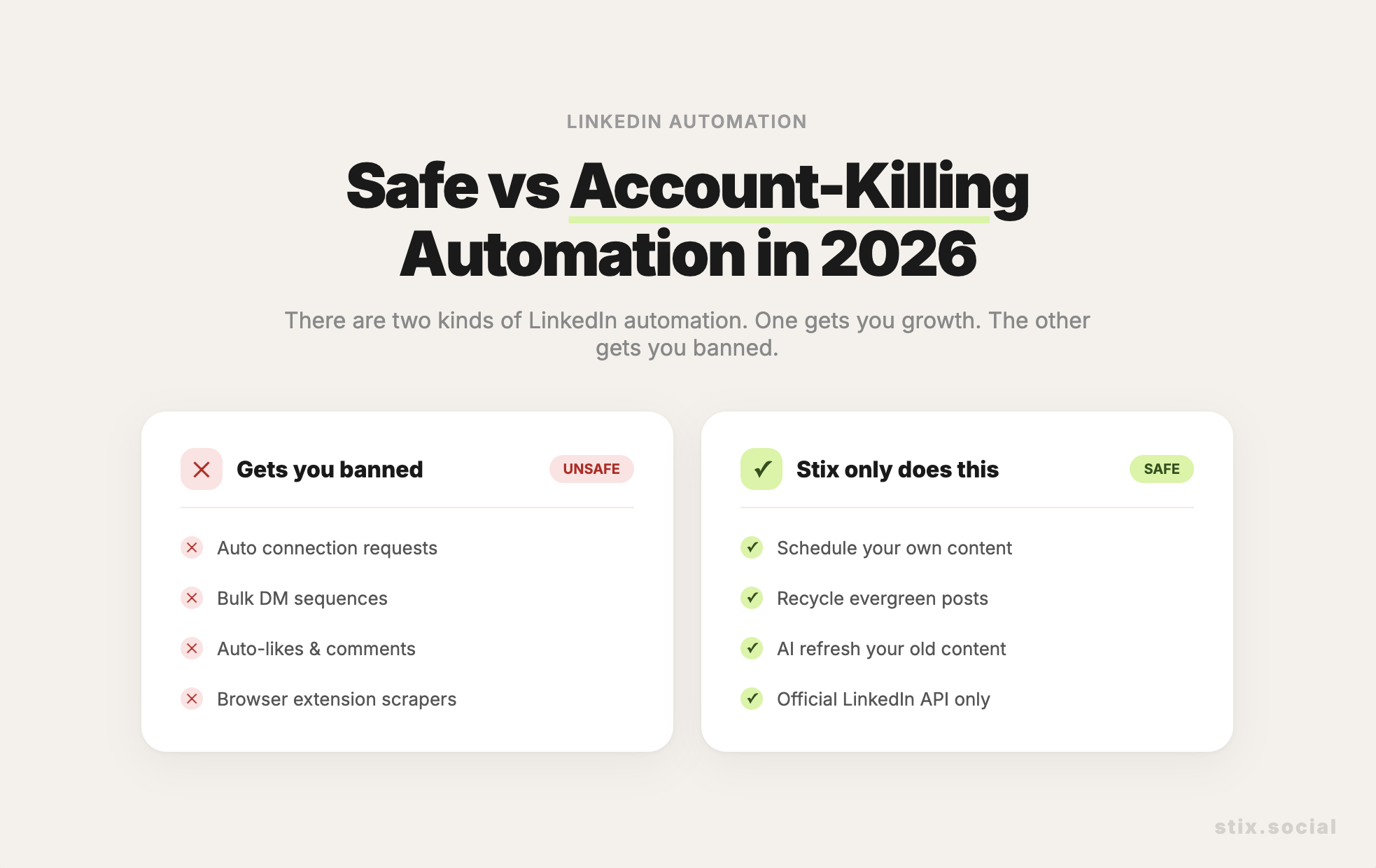
Tools like Stix automate this process by identifying your top-performing posts, generating AI-refreshed variations, and scheduling them into your content rotation automatically.
Step 5: Use a Scheduling System That Runs Without You
The final piece is automation. A good scheduling tool removes the need to manually publish every post. But the best tools go further than scheduling. They handle the rotation of your content library, ensure no category gets neglected, and keep your feed active even during your busiest weeks.
The difference between a scheduler and a consistency engine is this: a scheduler requires you to fill empty time slots. A consistency engine draws from your library and keeps posting on your behalf, even when you are not actively feeding it new content.
A Realistic Weekly Time Commitment
With this system in place, your weekly time investment looks like this: 15 minutes reviewing and approving scheduled posts, occasional 90-minute batching sessions every two weeks, and zero time spent staring at a blank screen wondering what to write. That is the difference between a sustainable LinkedIn presence and the feast-or-famine cycle that burns out most founders.