


The Difference Between Generation and Rewriting
AI content tools fall into two categories, and the difference matters.
Generation tools create new content from a prompt. You give them a topic and they write a post. The output reflects the model's training data, which means everyone using the same tool gets variations of the same content. The voice, structure, and rhythm all converge toward whatever the model considers "good LinkedIn writing."
Rewriting tools take content you have already written and produce a variation of it. The source material is your own voice, your own framing, and your own examples. The AI's job is not to invent. It is to rephrase, restructure, and refresh while preserving everything that made the original sound like you.
For founders building a personal brand, the second category is the only one that scales without destroying the brand. The first category produces a faster output but a worse asset.
Why Refreshing Old Content Beats Writing New Content
The math here is brutal and most founders ignore it.
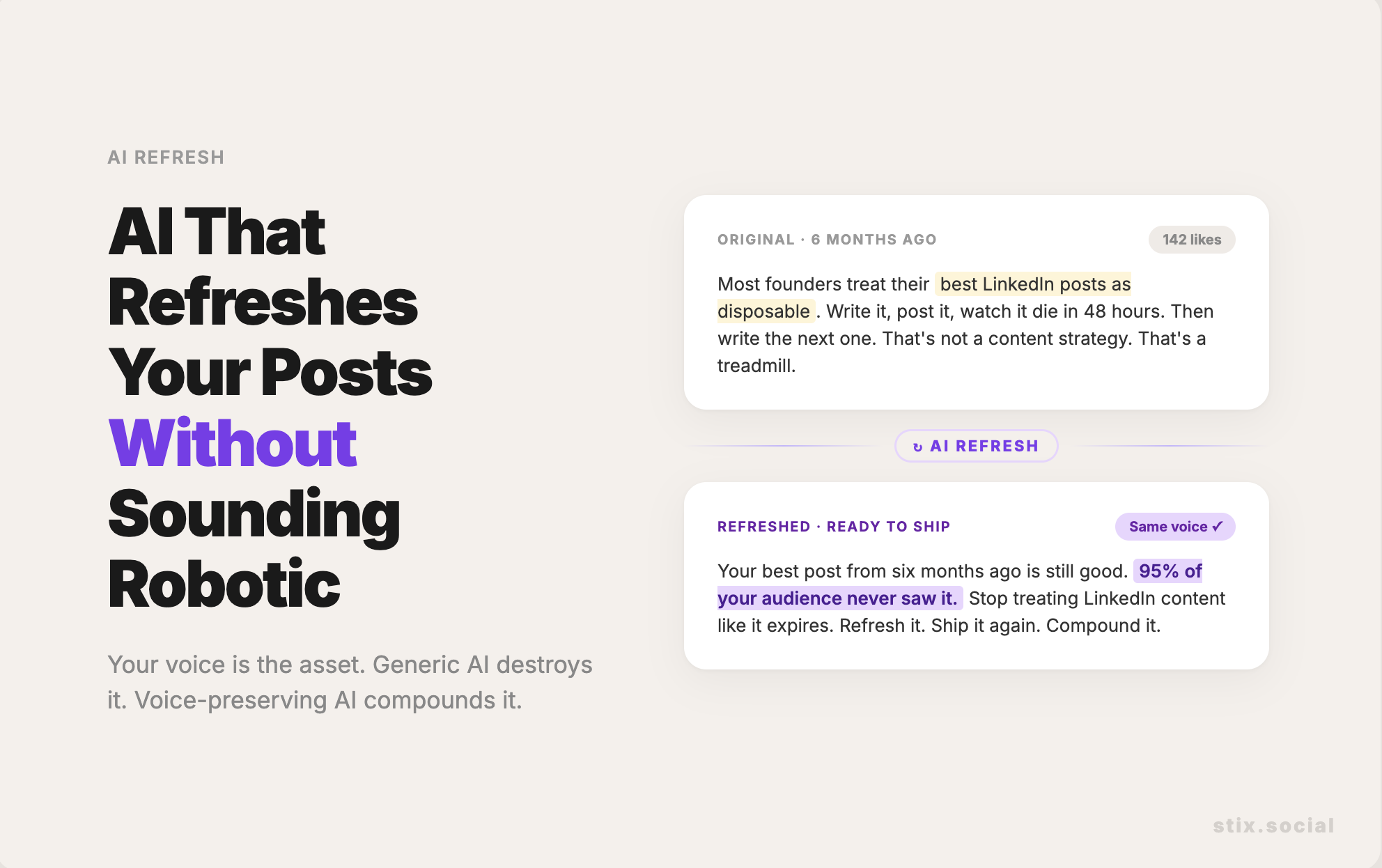
Your best LinkedIn post from six months ago was seen by maybe 5 percent of your followers. The other 95 percent never saw it. Your audience has grown since then. Your old high-performing posts are still relevant, still useful, and still completely unseen by the people who follow you today.
Writing a brand new post on a topic you have already covered is a worse use of time than refreshing the original. The original already proved it works. The refresh capitalizes on a known asset. The new post is a guess.
The reason most founders do not do this is operational. They cannot remember what they posted six months ago. They cannot find it in their LinkedIn archive. They do not have a system for resurfacing it. An AI rewriter solves the rewriting problem. A LinkedIn-first tool with a content library solves the surfacing problem. You need both.
What Voice-Preserving AI Actually Looks Like
The technical difference between an AI rewriter that preserves voice and one that does not comes down to how the prompt is constructed. Generic tools use a template like "rewrite this post." Voice-preserving tools use a richer instruction set.
A good AI LinkedIn post rewriter analyzes the source post for tone (casual, formal, sarcastic, professional), structure (story-first, framework-first, list-based), rhythm (short punchy sentences, longer flowing paragraphs), and signature phrases (the way you open hooks, the way you close posts, the words you actually use). Then it generates a variation that matches all of those dimensions.
The output should be different enough that someone re-reading it does not feel deja vu, but similar enough that your audience cannot tell it was AI-touched. The test is whether your closest colleague would notice. If they would, the rewrite failed.
The Three Refresh Modes Worth Having
Not every refresh should be the same. The right tool gives you control over how aggressive the rewrite is.
Light refresh. Same structure, same examples, different sentence-level wording. Use this for posts that performed well and you want to ship again with minimal risk. The output reads as a polished version of the original.
Reframe. Same core idea, different angle or hook. Use this when the topic is still relevant but the original framing has been used up. A post about "why you should niche down" can become "the one question that tells you when to niche down."
Format shift. Same content, different format. Turn a story post into a framework post. Turn a long-form post into a carousel outline. Turn a framework into a question post. This is the most powerful mode because it lets one piece of content live three or four lives.
The Workflow That Compounds
The way founders should actually use an AI LinkedIn post rewriter looks like this.
Once a month, review your top 10 performing posts from the last 6 to 12 months. For each one, decide which refresh mode fits: light refresh, reframe, or format shift. Run the rewrites. Schedule them across the next 30 days as part of your normal posting cadence.
That single workflow, done once a month, gives you 10 to 15 high-performing posts ready to ship without any new content creation. Combined with your normal new-content output, your total monthly volume doubles or triples without any additional writing time.
The compounding effect is that your content library becomes more valuable every month, not less. Most founders treat LinkedIn posts as disposable. A founder using AI refresh treats them as renewable.
The Stix Approach to AI Refresh
Stix's AI rewriter is built on the principle that voice is the asset. The tool learns your writing patterns from your existing post library, then applies those patterns to every refresh. The result is content that sounds like you wrote it on a slightly different morning, not content that sounds like a chatbot wrote it on your behalf.
Combined with category-based scheduling and content recycling, the AI refresh feature is the layer that makes set-and-forget LinkedIn posting actually work without sounding generic. See how Stix's AI refresh works and stop letting your best content die after one impression.
The Bottom Line
AI LinkedIn tools are not all the same. Generation tools produce content that gets you to volume but costs you brand. Rewriting tools amplify the content you already produced and make your library a compounding asset. For B2B founders who care about how they sound, the second category is the only category that matters.