



You know you are doing incredible work. You know your team is solving hard problems. You know you have insights that could help thousands of people. But if someone looks you up online, it looks like you went out of business six months ago.
I lived with this guilt for years, specifically during my time building my previous company, Braingineers.
We were doing fascinating, complex work. We were deep in the world of emotion analytics and user experience. We had happy clients and a growing team. But if you clicked on my LinkedIn profile during the busiest, most successful periods of that company, you would see… nothing.
Silence.
This is the story of why that silence happened, why I think it kills more startups than we admit, and the specific search for LinkedIn automation that led me to build Stix.
The Braingineers paradox
At Braingineers, I fell into what I now call the "Founder’s paradox."
The paradox is simple: The times when you have the most valuable insights to share (when you are scaling, firefighting, and winning) are the exact times you have zero capacity to share them.
I would spend weeks deep in strategy or product development. I was learning lessons about B2B sales and tech scaling that I knew other founders would kill to hear. But by the time I got home at 8 PM, the last thing I wanted to do was open a social media scheduler, find a stock image, and think of a witty caption.
So, I didn’t. I went months without posting. My "Activity" feed turned into a ghost town.
Then, the guilt would hit. I would look at competitors—people with half our experience but twice the visibility—and get frustrated. I would think, "I need to fix this."
The 'feast or famine' cycle
My solution back then was always the same. I would force myself into a "content sprint." I’d block out a Sunday, drink three coffees, and write four or five articles in a row. I felt productive. I felt like I was finally taking personal branding seriously.
I would schedule them out. For two weeks, I was everywhere. I was consistent. I was a thought leader.
But then the scheduled posts ran out. Real life at Braingineers would take over again. Two weeks of noise would be followed by four months of silence. This is the "feast or famine" cycle, and it is exhausting.
The problem with 'LinkedIn automation'
I started Googling for solutions. I typed in things like "how to grow on LinkedIn" and "LinkedIn automation tools."
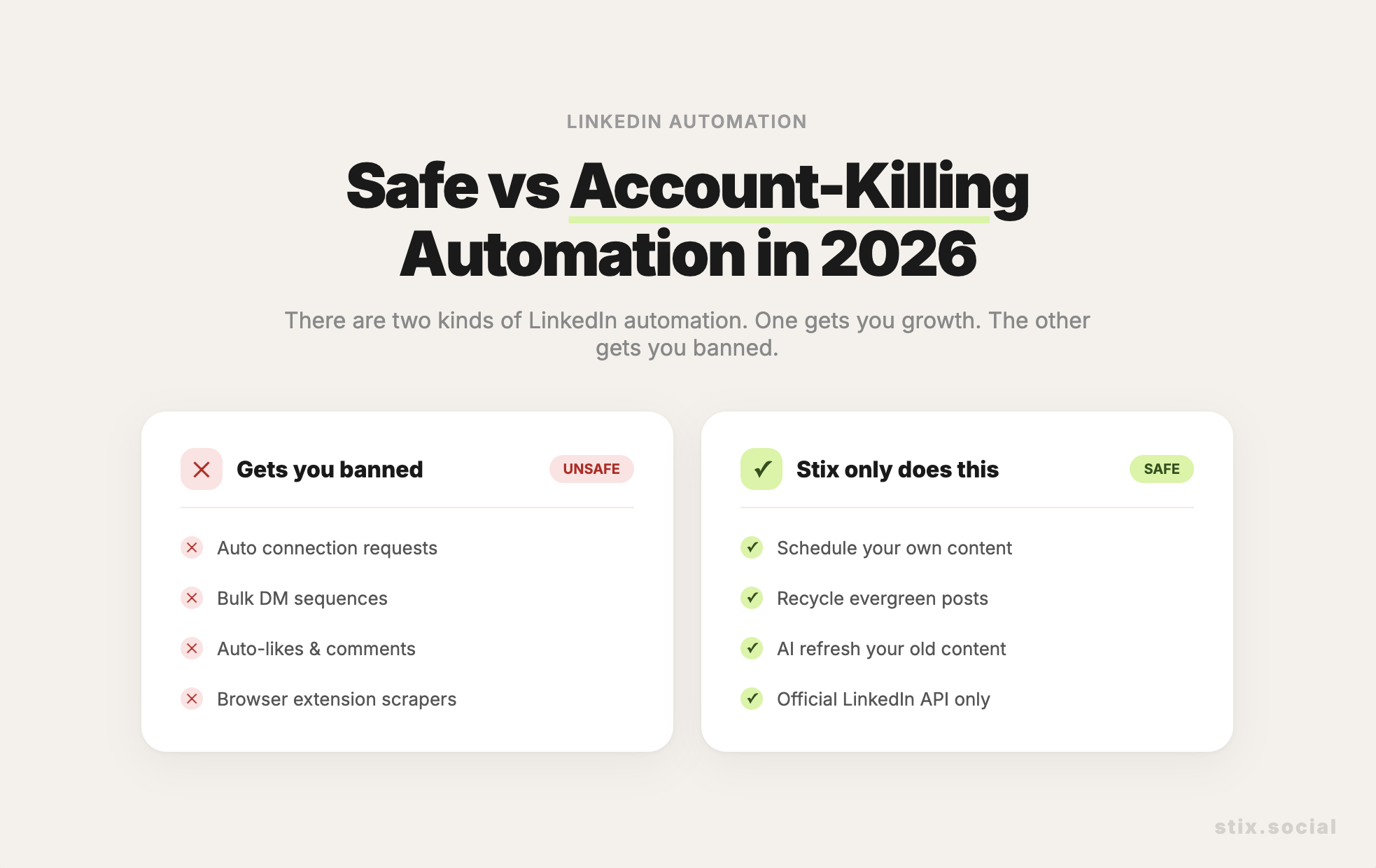
I quickly realized that the term "LinkedIn automation" is a minefield. Most of the tools I found were designed to be spam bots. They promised to automatically visit profiles, send 100 connection requests a day, and spam people’s inboxes with generic sales pitches.
That wasn't what I wanted. I didn't want to automate my relationships; I wanted to automate my consistency.
I looked at the other side of the market—the content schedulers like Buffer and Hootsuite. But these weren't true automation. They were just empty calendars. They still required me to feed the beast every single week. If I stopped writing, the machine stopped working.
Then there were the "recyclers." These were closer to what I needed. They took old posts and reposted them. But they did it lazily. They would copy-paste the exact same text block over and over. It looked robotic. It signaled to the world: "Max isn't here right now, this is a script."
The realization: content as an asset
The turning point for me wasn't finding a new tool. It was a change in philosophy regarding LinkedIn automation.
I realized that if I wanted to survive the busy periods of startup life without disappearing, I needed to treat my content like evergreen assets, not disposable daily tasks. If I wrote a deep-dive post about "Client Retention in SaaS" in January, why was that post dead by February?
I needed a system that did three things:
1 - Capture my voice once: Let me write when I’m inspired.
2 - Organize for the long term: Sort ideas into categories, not just dates.
3 - Automate intelligently: Resurface those ideas months later, but force me to refresh them so they never look stale.
The philosophy of 'Stix'
Stix wasn't built to be a unicorn software company initially. It was built to solve Max's problem.
I wanted a place where I could dump my best ideas once, categorize them, and know that they would keep working for me forever. I wanted safe LinkedIn automation—automation that handles the logistics but leaves the creativity to me.
I didn't want "set and forget." I wanted "remind and refresh."
I wanted a prompt that said: "Hey Max, this post about leadership did really well 6 months ago. Here is a suggested rewrite to make it fresh. Do you want to post it?"
That subtle shift changed everything for me. It gave me the consistency of a machine with the voice of a human. It meant that during the busiest weeks at Braingineers, my presence didn't disappear. My "digital twin" was still out there, sharing value, while I was heads-down working.
Why this matters
I am sharing this story because I meet founders every week who are stuck in the same trap. They have incredible stories to tell. They have expertise that the world needs. But they remain the "best-kept secret" in their industry because they can't stay on the content treadmill.
Marketing shouldn't feel like a second full-time job. It should be a system that amplifies the work you are already doing.
We built Stix to be that system. It is the tool I wish I had five years ago. It’s for the founder who is too busy to post, but too smart to disappear.