


.webp)
I am a huge fan of automation. As a founder, I have to rely on tools to get things done. I automate my invoices, my meeting scheduling, and my email sorting. But I have learned one strict rule the hard way: you should never automate your voice.
A few years ago, I tried to solve my "inconsistent posting" problem with a tool called MeetEdgar. If you have been in marketing for a while, you know the name. They were the pioneers of "content recycling." Their promise is simple and very attractive: you build a library of posts, and when you run out of new content, the tool automatically grabs an old post and shares it again.
The concept is brilliant on paper. Why write something new every single day when you have a goldmine of old content that performed well?
I signed up, loaded my library, and felt a sense of relief. My LinkedIn was on autopilot. But that relief turned into embarrassment about two months later. I looked at my own feed and saw a post I had written weeks ago. It was the exact same image. The exact same caption. Even the hashtags were identical.
It didn't look helpful. It looked robotic. It looked lazy. And because my network is smart, they noticed. I realized that while I was saving time, I was slowly eroding the trust I had built with my audience. I built Stix to fix this specific problem.
If you are looking for a way to stay consistent without losing your soul, here is the honest comparison between the old way (MeetEdgar) and the new way (Stix).
The "Zombie Post" Problem
MeetEdgar popularized the idea of the "evergreen queue." It works like a jukebox. It plays a song, and eventually, when the playlist finishes, it plays that song again.
This approach was designed for a different era of the internet, specifically for Twitter (now X). On X, the feed moves at lightning speed. A tweet has a lifespan of about 15 minutes. If you tweet something at 9 AM, nobody sees it at 5 PM. So, reposting the exact same text is a smart strategy to capture a different audience.
But LinkedIn is not Twitter.
LinkedIn is a professional network with a much slower, "sticky" feed. A good post on LinkedIn can stay in people's feeds for 3, 4, or even 5 days. If you have a connection who engages with your content, the algorithm will show them your posts frequently.
When MeetEdgar loops your content, it creates "Zombie Posts"—content that is walking around but has no life in it. If a potential client sees you posting the exact same paragraph word-for-word every few months, it signals that you are not present. It suggests you are treating them like a metric, not a relationship.
Stix: Recycling with a Brain
With Stix, we believe in "Smart Recycling." We know that your old ideas are valuable. If you wrote a great tip about B2B sales six months ago, it is still true today. But it needs a fresh coat of paint.
Stix does not just copy-paste. We built an AI engine specifically for this moment.
When Stix identifies a high-performing post from your past, it acts like a skilled editor. It analyzes the core message of your post and suggests a variation. For example:
- Original Post: A "How-to" listicle about managing remote teams.
- Stix Variation: A personal reflection on a mistake you made when managing a remote team, leading to the same advice.
You get the benefit of recycling—you don't have to stare at a blank page and invent a new topic—but your audience sees something fresh. You look consistent, expert, and human.
The Danger of the "Black Box"
The other major difference is control. MeetEdgar is designed to run in the background. It is a "set it and forget it" tool. For a news publisher, that is a feature. For a founder protecting their personal brand, that is a risk.
I never wanted a tool that posts without my permission. I have had moments where news broke in my industry, or something tragic happened in the world, and my automated tool posted a cheerful "Happy Monday!" meme. It was tone-deaf and awkward.
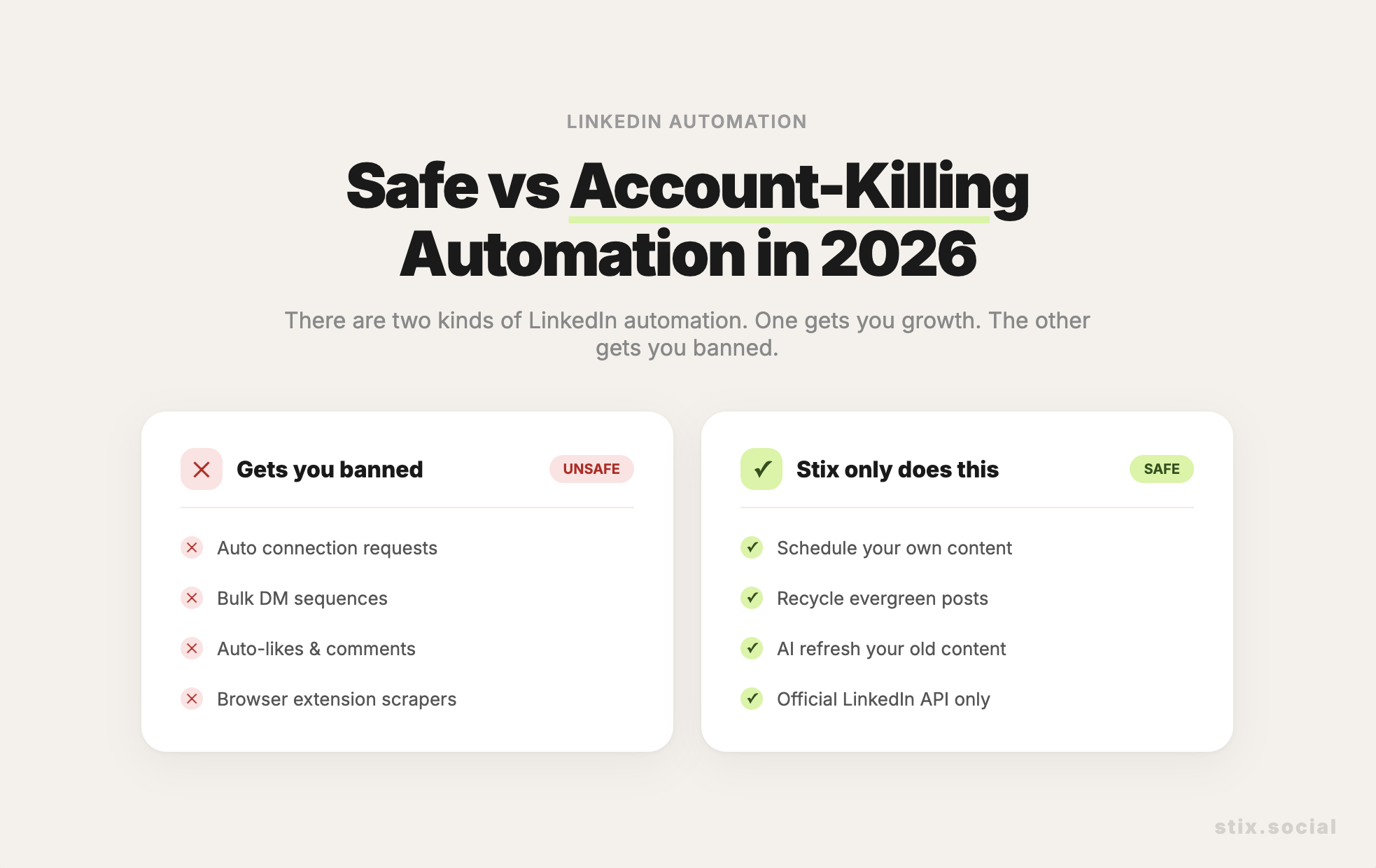
Stix operates on a "Human-in-the-Loop" philosophy. We do the heavy lifting—organizing the categories, queuing the posts, and generating the rewrites—but you press the final button.
My routine with Stix takes about 15 minutes a week. I log in, review the suggested schedule, tweak a few words in the AI-generated variations to make them sound more like me, and hit "Approve." I get the speed of AI, but I sleep well knowing exactly what is going out under my name.
Summary: Which Tool is Right for You?
I am not saying MeetEdgar is a bad tool. It is a powerful engine for brands that need to keep a high-volume Twitter feed or Facebook page alive 24/7. If you are running a news site or a meme page, it is fantastic.
But Stix is for professionals. It is for founders, consultants, and marketers who use LinkedIn to generate business. We give you the same time-saving power of a library, but we ensure you never look like a robot. Your network wants to hear from you, not your automation script.